
SC Senate Race 2026: New Polls Show Graham-Andrews Contest Tightening
SOUTH CAROLINA POLITICS | OCTOBER 28, 2026
Two South Carolina Polls Paint Different Pictures of Graham-Andrews Senate Race as Election Day Approaches
With less than a week before Election Day, new polling shows a competitive U.S. Senate race in South Carolina, with undecided voters, regional differences and President Trump’s recent Upstate rally drawing attention.
South Carolina voters are heading into the final days of one of the state’s most closely watched U.S. Senate campaigns in years, and two new polls are offering somewhat different pictures of the contest between Republican Senator Darline Graham and Democratic challenger Dr. Annie Andrews.
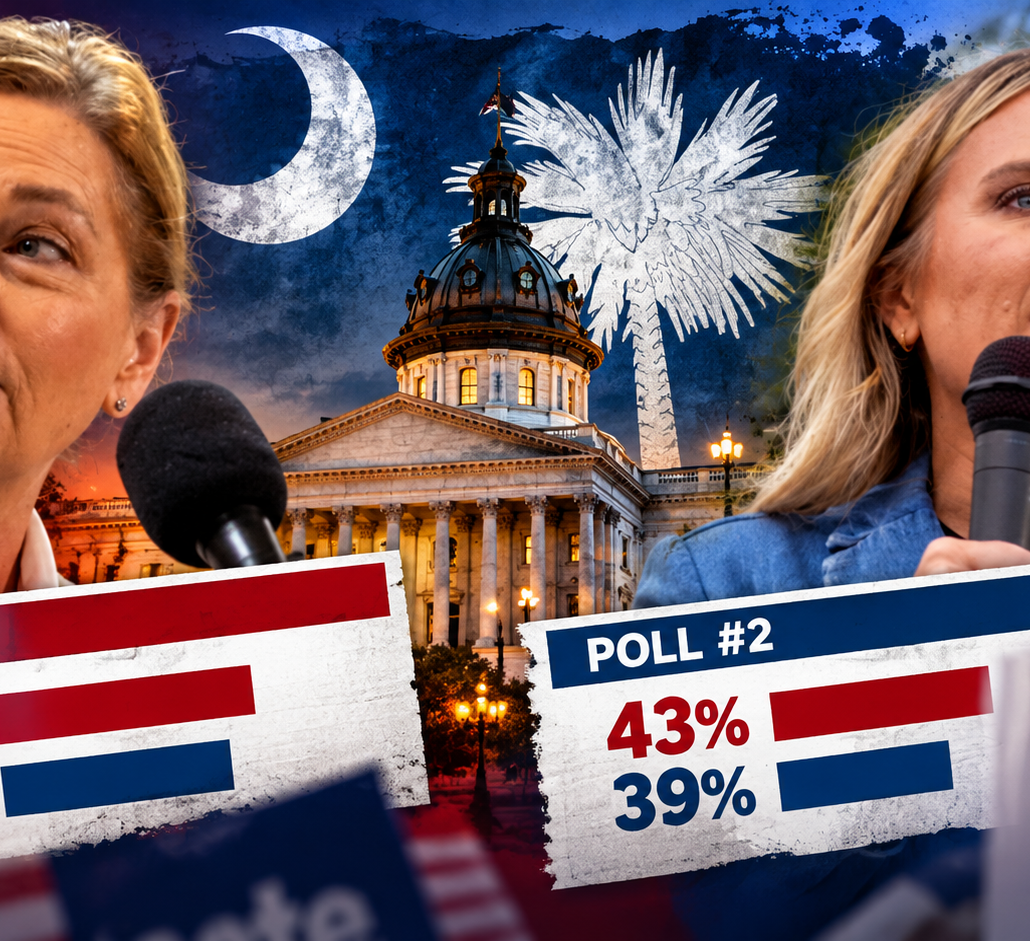
Both surveys, released this week by The Citadel and the South Carolina Policy Council, show Graham leading Andrews. However, the size of that lead varies, raising questions about voter turnout, the impact of President Donald Trump’s recent visit to the Upstate and how undecided voters will make their decisions before November 3.
And now, a third survey released Wednesday by The New York Times and Siena University shows the candidates tied at 48 percent each.
The Poll Numbers: A Four-Point Lead Versus a Statistical Tie
The Citadel surveyed 1,009 registered South Carolina voters and found Graham holding a four-percentage-point advantage over Andrews.
The South Carolina Policy Council’s Fall Poll, meanwhile, found a much narrower contest, with Graham receiving 47 percent support compared with 46 percent for Andrews among likely voters.
Latest South Carolina Senate polling
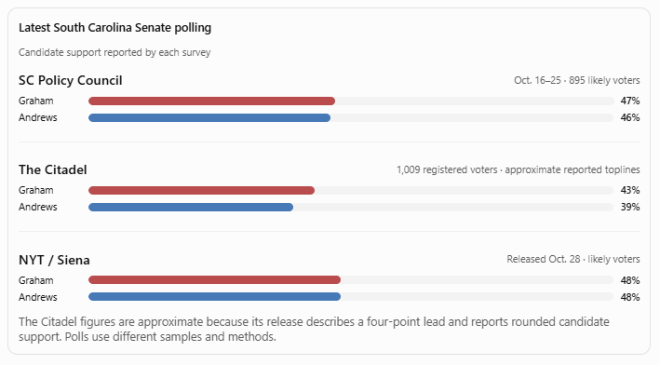
The Citadel figures are approximate because its release describes a four-point lead and reports rounded candidate support. Polls use different samples and methods.
The Policy Council survey also found Libertarian Kasie Whitener at 2 percent, Constitution Party candidate Mark Hackett at 1 percent and approximately 4 percent of voters undecided.
Its reported margin of error for the likely-voter sample was plus or minus 3.21 percentage points, meaning Graham’s one-point advantage falls well within the survey’s margin of error.
The Citadel found a considerably larger pool of undecided voters, with 14 percent of those expecting to vote saying they had not settled on a candidate.
That difference matters. The surveys are not necessarily contradictory; they reflect different sampling approaches, voter populations and periods of interviewing.
President Trump’s Upstate Rally: Did It Move the Numbers?
One of the more interesting findings from The Citadel poll involves President Trump’s October 21 rally in Pendleton in support of Senator Graham.
According to researchers, Graham’s advantage appeared to increase among respondents interviewed after the president’s visit.
Before the rally, Graham held a narrow advantage. Among respondents interviewed afterward, her support was seven percentage points higher, producing a ten-point advantage in that portion of the statewide sample.
The change was especially noticeable in the Upstate, where Graham’s lead grew from six percentage points among pre-rally respondents to 17 points among those interviewed afterward.
That is a significant difference in the survey results, although researchers cannot establish from those numbers alone that the rally caused the change. The smaller post-rally sample and other differences between respondents could also have contributed.
Still, the findings suggest the president’s visit deserves attention as campaigns examine how voters responded during the final stretch.
The Upstate and Lowcountry Are Telling Different Stories
The Citadel poll also highlights some striking regional differences.
In the Charleston area, Andrews led Graham 47 percent to 34 percent. In the Greenville media market, the numbers were reversed, with Graham leading 44 percent to 37 percent.
Graham also held an advantage in the Rock Hill and Florence markets, while the Columbia area showed a narrower division.
Another interesting finding involved how long voters have lived in South Carolina.
Among residents who moved to the state within the past five years, Andrews led 50 percent to 34 percent. Among native South Carolinians, the candidates were tied at 38 percent each.
Those findings raise an important question about South Carolina’s changing electorate. As the state continues to attract new residents, will the political preferences of those voters begin changing the traditional voting patterns in statewide elections?
The poll offers a snapshot of those differences, although it does not establish how new residents will vote on Election Day.
What Are Voters Most Concerned About?
While the campaigns have spent considerable time debating national politics and their differences on major social issues, the South Carolina Policy Council poll found that economic concerns remain central to voters.
Thirty-six percent of respondents identified the cost of living and inflation as the most important issue influencing their vote.
Another 14 percent cited democracy and the functioning of government.
Those findings suggest that, regardless of party affiliation, many South Carolinians are evaluating the candidates through the lens of household finances, the economy and confidence in government.
The Lindsey Graham Legacy and an Unusual Senate Election
This year’s Senate contest is unlike any South Carolina has experienced in recent memory.
Following the death of longtime Senator Lindsey Graham in July, his sister, Darline Graham, was appointed to the seat and subsequently secured the Republican nomination.
She is now seeking a full term while facing Andrews, a pediatrician who has focused much of her campaign on health care, affordability and a different approach to political leadership.
The Citadel survey found that 26 percent of Graham supporters cited continuing Lindsey Graham’s legacy as a reason for their support. Another 37 percent said they backed her because of the issues she emphasizes.
Among Andrews supporters, 47 percent said the issues important to them were the primary reason for their support.
The contest has also attracted unusual attention from prominent political figures, including former South Carolina governors David Beasley, a Republican, and Jim Hodges, a Democrat, who jointly endorsed Andrews this week.
The Final Days: Turnout Could Be Just as Important as Persuasion
With early voting continuing through Saturday, October 31, both campaigns have limited time remaining to reach undecided voters and encourage their supporters to cast ballots.
The polling leaves several important questions unanswered.
How will independent voters divide their support? Will the regional differences identified by The Citadel appear in the final vote totals? How many undecided voters will ultimately choose one of the major-party candidates? And how will the participation of younger voters, newer South Carolina residents and traditional party supporters affect the final results?
The Citadel found that 62 percent of respondents believed Graham would ultimately win, regardless of their own candidate preference. But expectations about an election are not the same as actual voting intentions.
The newly released New York Times/Siena survey, showing the candidates tied at 48 percent, provides another reminder that the different polls are measuring a contest with meaningful uncertainty.
The Bottom Line
For South Carolina voters, the takeaway is that this Senate race deserves close attention.
The Citadel survey shows Graham with a four-point advantage, while the South Carolina Policy Council has the candidates separated by just one point. The latest New York Times/Siena poll finds them tied.
All three surveys underscore the importance of understanding not just the headline numbers but also the voters being surveyed, the number still undecided and the differences between regions of the state.
On Tuesday, November 3, the polls will give way to actual ballots, and South Carolinians will decide who represents them in the United States Senate.
For continuing coverage of the South Carolina elections, political analysis and interviews with the candidates and newsmakers, visit JoeyHudson.com.


Leave a Reply
Want to join the discussion?Feel free to contribute!